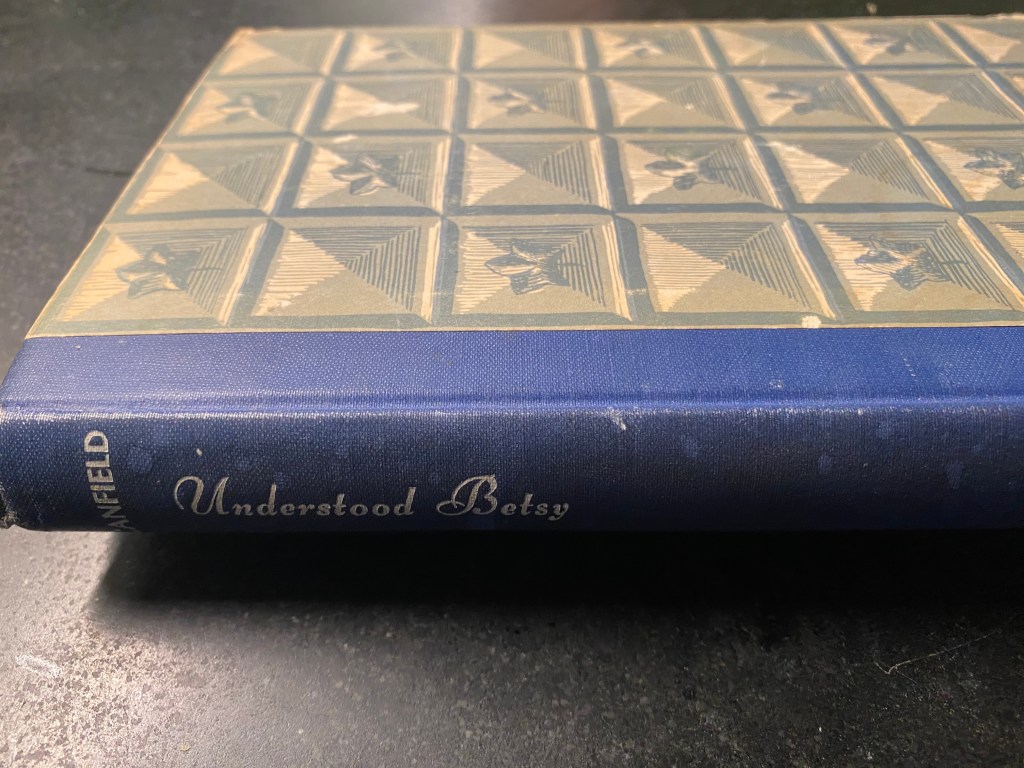
- Age: 10+
- Particulars (Out of 5):
- Pure happiness at the end *****
- Beautiful story *****
- Positive role models *****
- Inappropriate language: None.
- Sexual references: None.
Reminder: Nana’s Books are rated G. Anyone could read them, or listen to them being read aloud.
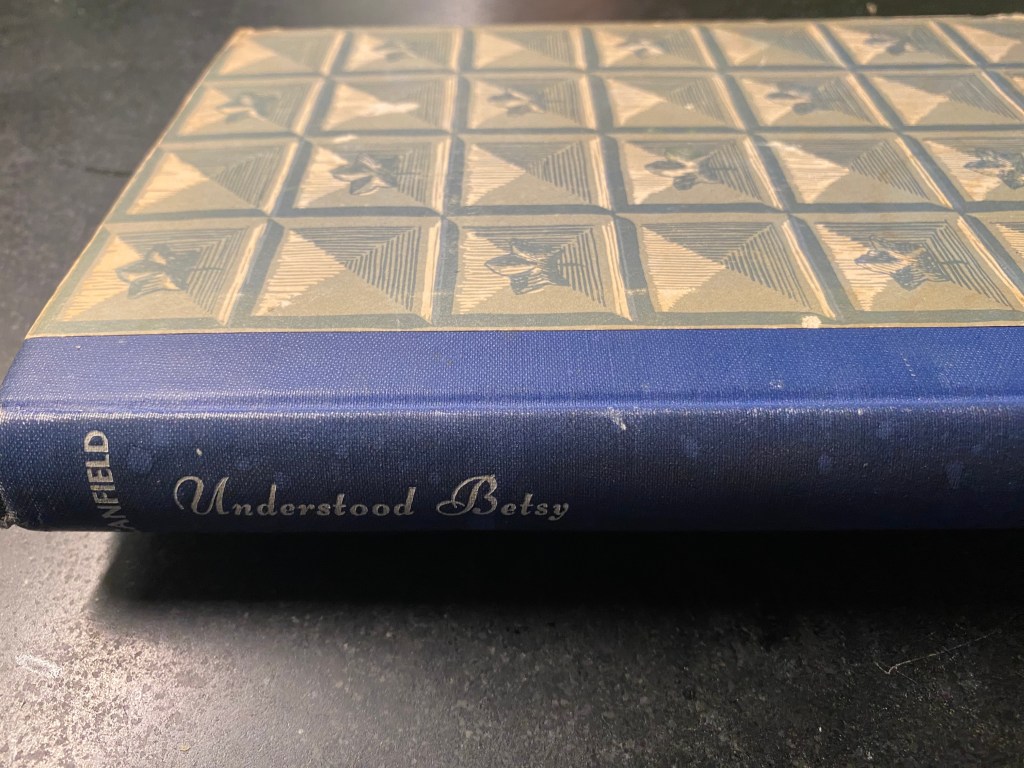
My copy was printed in 1946, and on the inside front cover, written in pencil: “This book belongs to: Gayla H. Dennis”– my mom. She loved this book, and when I was in the third grade or so, she gave it to me, and I have loved it all my life. The story is just wonderful.
When we first meet Elizabeth Ann, age 9, she’s living in a fearful bubble somewhere in the Midwest, being raised by her fearful and neurotic Aunt Frances. Aunt Frances loves her niece very much, but bless her heart – she overthinks everything. Not only that, she pre-conditions Elizabeth Ann to worry and be fearful, too, of pretty much everything: big dogs, tests at school, not having an appetite, being sickly, and having nightmares. (Elizabeth Ann wasn’t having nightmares until Aunt Frances started telling her not to worry about them. For that matter, Elizabeth Ann has heard all her life how she doesn’t have much of an appetite, so she doesn’t eat much!). Because Aunt Frances does everything for her, Elizabeth Ann doesn’t know how to do much for herself. She hasn’t even had a lot of practice thinking for herself: the school has seen to that.
But then Elizabeth Ann’s life suddenly changes: Great-Aunt Harriet, Aunt Frances’ mom, develops a cough, and it turns out that she is very sick. Aunt Frances must take her at once to a warm climate, and Elizabeth Ann should not go, because – at the doctor’s orders – Aunt Frances will need to devote herself entirely to helping her mother. Elizabeth Ann winds up headed for Vermont, to the farm of relatives she has never met: The Putneys, Uncle Henry, Aunt Abigail, and Cousin Ann.
And from here on out, she is Betsy – the Putneys’ name for her. The Putneys are awesome. Unlike Aunt Frances, they don’t encourage Betsy to air every single thought or worry or fear. They just love her, and from the get-go, they give her things to do, assuming she is old enough and competent enough to do them. Every time, Betsy proves them right — rising to the occasion and surprising herself. Uncle Henry comes to meet Betsy’s train, and promptly gives her the reins (remember, this was written in 1916!) on the way home. The wagon is driven by slow, heavy plow horses, and although Betsy has trouble telling her left from right, she figures out how to make them stay on the road.
At Putney Farm, she meets Aunt Abigail, gentle, grandmotherly cushion of a woman who makes Betsy feel secure – although Betsy doesn’t recognize it at the time – for the first time in her life. “She felt as though a tight knot inside her were slowly being untied.”
I can’t do justice to how good this book is. Betsy learns about self-sufficiency from her relatives, and from Aunt Abigail’s stories about their shared ancestors – who, back in the day, didn’t have matches, didn’t have stores to buy them even if matches had existed, didn’t have stoves, but cooked over the fire, and made their own pencils for school by pouring lead. They settled in Vermont with everything they owned packed on horses; they couldn’t use wagons because there were no roads. Betsy comes from hardy stock, and becomes hardy, herself.
Her new school is a one-room schoolhouse, and as a homeschool mom, I loved this so much.** Betsy is behind where she should be (third grade) in math, but way ahead (seventh grade) in reading. In fact, her teacher immediately sets Betsy to helping a much younger girl, Molly, with her reading. When Betsy gets nervous and bombs a test – in a panic, giving the wrong answers when she knew the right ones – Cousin Ann blows her away: “’It doesn’t matter if you really know the right answers, does it? That’s the important thing.’ This was an idea which had never in all her life entered Betsy’s brain…”
Betsy has more of the Putney self-reliance in her than she realizes, and in several key adventures, she saves the day by thinking for herself – trying to do what Cousin Ann would do – and coming up with a plan. With some of the girls in her class, she does an act of charity and, learning another important lesson, realizes that to do it anonymously is much better than taking credit for it.
Understood Betsy has one of the sweetest endings of any book ever. I’m not going to spoil it for you.
**Fun fact: Dorothy Canfield Fisher, the author, was an educational reformer who brought the Montessori method of child-rearing to the U.S., and was a huge advocate for the Montessori method of teaching. Betsy’s schoolhouse in the book is run a lot like a Montessori school.
This book is available as a Kindle and in paperback, new and used on Amazon. It is also available used in hardcover and paperback on eBay and Abebooks.
©Janet Farrar Worthington
Note: I am an Amazon affiliate, so if you do click a link and buy a book, I will theoretically make a small amount of money, but I’m just starting this thing, so I don’t even know how that works. Still, full disclosure, etc.

 Nana's Book Library
Leave a comment