Wow, our ancestors were tough! This incredible book is told from the perspective of Stephanie Venable, age 13. The year is 1780. The Revolutionary War is still being fought, although not with much enthusiasm. In fact, most of the colonists — the majority of them farmers — aren’t interested in the fighting; they’re too busy just trying to get by. They don’t like the British taxes, but they don’t want to leave their families and farms to go serve in Washington’s Continental Army. General Washington doesn’t have much to work with: his ragtag soldiers are starving and underdressed, literally: they don’t have uniforms, their shoes have worn out and their clothes are falling apart. Francis Marion, the “Swamp Fox,” is making a stand in South Carolina with the few men he has. George Rogers Clark, with his few men on the Western front (Kentucky and Ohio), has pushed back the Indians, some of whom are being paid by the British to raid the settlers’ homes and cause unrest.
So here we find the Venable family: Jonathan, Bertha, oldest son Noel, Stephanie, age 13, Rob, age 10, and younger siblings Willie and Cassie. They are heading west, to the great promise of Kentucky – with its black earth, good for growing crops. They can’t bring much with them, just what they can carry and put on their one horse. Their horse is loaded with two large baskets, in which ride the two youngest children, and the tools that the family will use to carve out, literally, a home and farm for themselves in Kentucky. The Venables walk the whole way, from North Carolina to Kentucky, with the horse, their cow, a few pigs and sheep, their three chickens in a basket, tools – just the metal parts; they make handles for them when they get there – and what food they can bring along. They are moving away from the British taxes. Jonathan has bought 400 acres of land.
Jonathan can’t read, but he knows how to survive and take care of his family. Bertha comes from a wealthy Hugenot family, French Christians who lost their wealth when they bought slaves to set them free. To their dismay, they barely made a dent in slavery and many of their friends, who had embraced slavery, turned against them. Noel takes after Bertha’s side of the family; he idolizes his Uncle Lucien, loves reading and playing music and carving beautiful things out of wood — activities Jonathan finds frivolous – and wants to fight against the British for America’s freedom. Kentucky, for all its promise, is not yet free, and if the British win, it, too, will be taxed and the land might be taken from the Venables and other families there. Stephanie loves her whole family, and feels the tension between Noel and Jonathan deeply. She’s also brave, hard-working and strong enough to keep the family and farm going when Noel and Jonathan, on separate missions, are gone for weeks.
Stephanie’s one thing she brings for herself from North Carolina? An apple seed! A lone apple seed descended from a very special tree that her grandmother had brought from France. This seed faces just as much of a struggle as the rest of the family: it gets eaten by a chicken and, as a little sapling, is shot by a British land grabber! But this little Tree of Freedom, like Stephanie, is tougher than it looks.
What do these brave settlers do when they reach their land? They start clearing it, using a hoe for the weeds and an axe to fell the trees. They plant rows of corn around the tree stumps to get the crops in the earth before they start to build their homes. Every seed is precious; each kernel of corn equals one hoe cake (like cornbread). For the Venables, bread is months away. Until the corn is harvested, they eat squirrel, bear, deer, wild turkey, berries, rabbit, nuts, and whatever plants they can forage in the woods, along with milk from their cow. They are starting their new lives from scratch, even making their own plates and utensils and all their furniture. They also make the spinning wheel that Bertha will use as the first step for the clothes she will weave, knit and sew for her family.
Note: Rebecca Caudill uses dialect to show the Southern accent, and she uses the terms of 1780. Most of these can be figured out by context; for example, a “piggin” is a wooden bucket with a handle, used for milking. This can be challenging for the reader, until you get used to it, but persevere. It’s worth it! This book is so well-written and compelling that even this week, as I just reread it, I felt like I was back in time, right there in the woods with Stephanie.
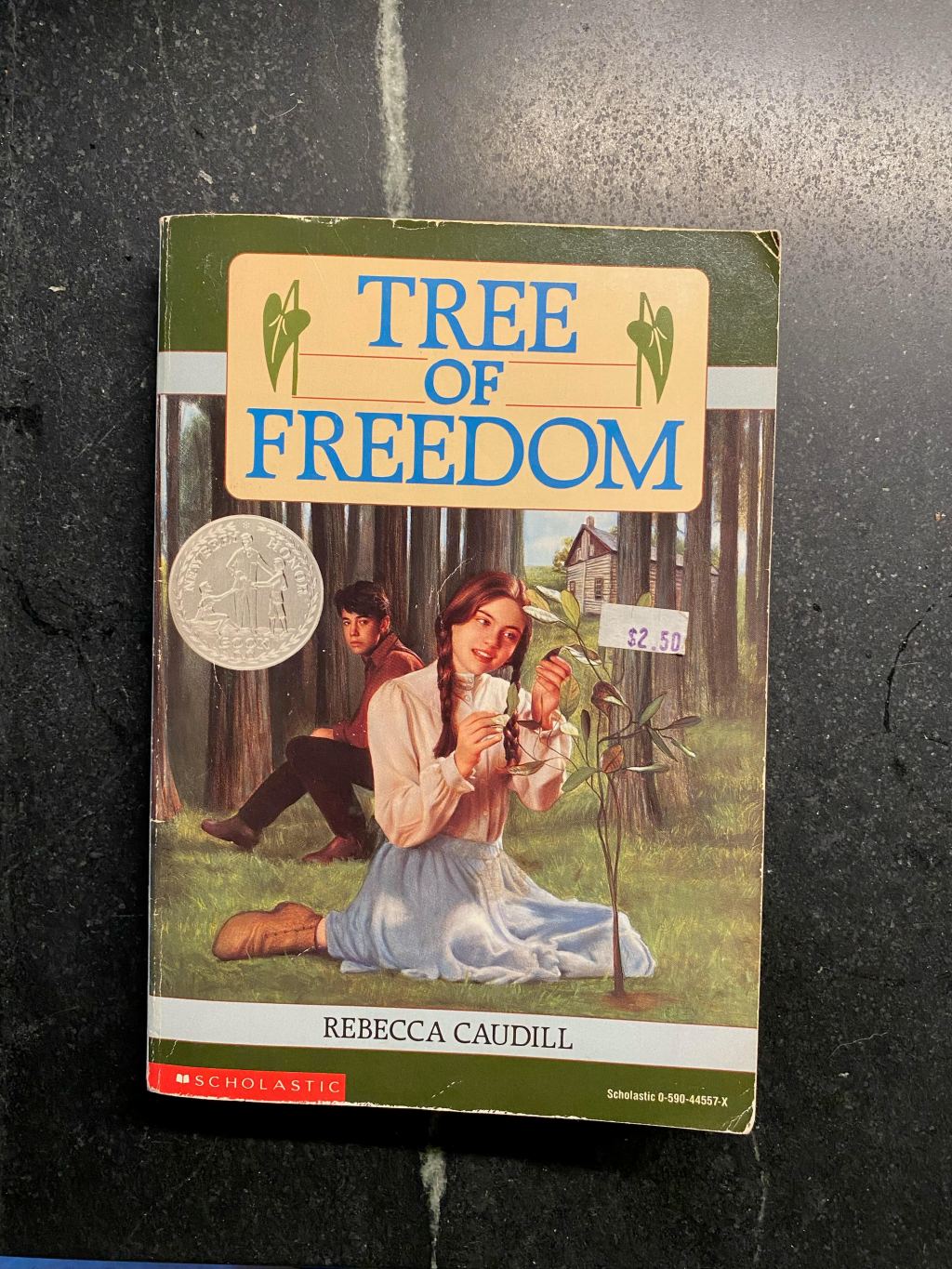
This book is available in hardcover, Kindle and paperback on Amazon. It is also available used in paperback and hardcover on eBay and Abebooks. I got my copy used, as you can see from the unfortunate price tag on the cover (it wouldn’t come off!).
©Janet Farrar Worthington
Note: I am an Amazon affiliate, so if you do click a link and buy a book, I will theoretically make a small amount of money, but I’m just starting this thing, so I don’t even know how that works. Still, full disclosure, etc.

 Nana's Book Library
Leave a comment